
Our Blog

What is an Epiretinal Membrane?
During your annual eye exam, our optometrist will assess the health of your eyes. This will include a check of your glasses prescription and the condition of the inside and outside of your eyes. At the very back of the eye is the retina, a layer of nerves that is...

Is Sleep Important for Your Eyes?
A good night’s sleep is important not only for optimal cognitive functioning but also for the health of the body and eyes long term. Unfortunately, there are certain conditions that can cause an individual to get a less than optimal night of sleep, or that affect how...

Ocular Allergies and Your Eyes
Allergic reactions can occur throughout various parts of the body. Whether it is a reaction that causes closing of the airways or a rash on the skin, all allergic reactions are responses from the body. In the eyes, a common allergic reaction is referred to as allergic...

Why Do I See Floaters in My Vision?
It is possible that at your last eye examination, your optometrist may have mentioned the importance of coming back to the clinic if you ever experience flashing lights or are noticing new floaters in your vision. However, when you come into the office in this case,...
Why Do My Eyes Water?
Our eyes are constantly producing tears to lubricate, protect, and keep them healthy. Sometimes, however, they can produce far too much water, resulting in blurry vision, tears running down our cheeks, etc. There are several causes and solutions for this, and these...
How High Blood Pressure Can Affect Your Eyes
At our office, a photo of the back of your eyes is often taken as a part of the eye exam. This provides our optometrist with a snapshot of the blood vessels and nerve layer. The photograph is a great way to document the findings at the back of the eye and serves as a...
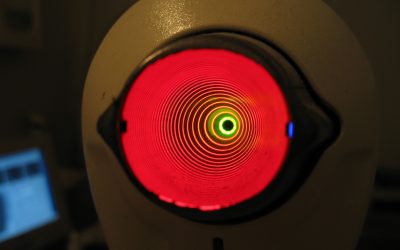
What is Keratoconus
Keratoconus is a disease that affects around 0.054% of the USA population. There are a variety of reasons that keratoconus can arise and in the past few years, lots of new technology has emerged to help treat it. Our optometrists can provide you with the right...

What is Color Blindness?
It is likely that at some past eye examination, you have been screened for color vision deficiencies. Often, this comes in the form of asking you to discriminate a number/ shape from a background of random colored dots. Color vision deficits can be something that you...

Everything You Need to Know About Dry Eye
Dry eye is a disorder of the tears that commonly causes discomfort and eventual damage to the front surface of the eye. There are many different causes and components to the disease, which make it complicated to treat and assess. Once you get it diagnosed, however,...

What is a Visual Field Test?
The “visual field” is defined as “the area or extent of physical space visible to an eye in a given position” by the Dictionary of Visual Science. Perhaps you have opened up this article because your optometrist has recently recommended that you complete a visual...

Options for Myopia Control (Nearsightedness)
During your child’s eye examination, your optometrist may have discussed myopia control with you. Myopia is more commonly known as nearsightedness, which is when we require vision correction to see more clearly in the distance. If a child is myopic when they are...

Understanding Strabismus and Lazy Eye
An eye condition known as strabismus can result in misaligned eyes and can cause vision problems such as eye strain, headaches, decreased vision, or double vision. In strabismus, one eye is aligned and looking straight ahead, while the other eye is turned inward...